DigitalXForce

Home » Solutions » Verifiable Third-Party Risk Management

Solutions > Verifiable Third-Party Risk Management

Verifiable Third-Party Risk Management

Verifiable third-party risk management backs every vendor decision with evidence an auditor can check, rather than a questionnaire answer taken on trust. DigitalXForce does this in the Third-Party Risk Management module, which scores each vendor from questionnaire answers, evidence and external signals and sorts vendors into a three-tier risk model, while the External Risk View watches each supplier from the outside between reviews. It runs on the TRiSCM platform, and the terms used here are defined in the DigitalXForce glossary.

Continuous Control Assurance (CCA) uses evidence, monitoring and validation to determine whether controls continue to operate as expected. Vendor scores and internal control results share one data layer. In X-ROC, a vendor event and a failed internal control sit in the same queue, ranked by quantified business impact.

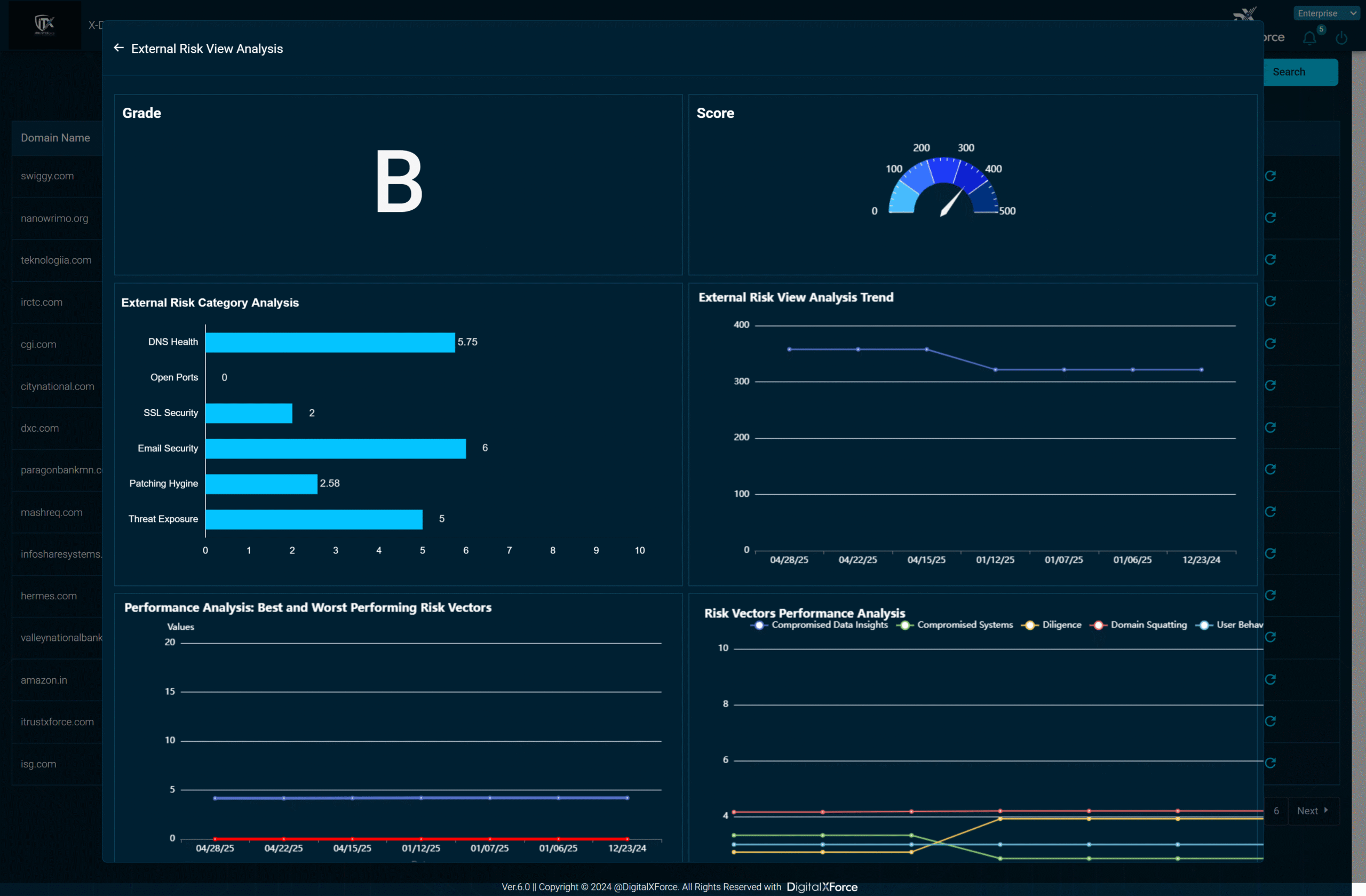
This screenshot shows the DigitalXForce External Risk View analysis for a vendor with a grade of B, the score trend and the risk category breakdown.

What We Give You

This icon shows two people with a gear and a warning sign.

Third-Party Risk Register

Track every vendor’s risk level and assessment status.

This icon shows a clipboard with a magnifying glass.

Evidence-Based Assessments

Back every decision with verifiable audit trails.

This icon shows a gauge with a gear and a magnifying glass.

Automated Due Diligence

Evaluate vendors with less manual effort.

This icon shows a document flow with arrows.

Remediation Workflows

Enforce corrective actions efficiently.

This icon shows a report with a chart and a check mark.

Audit-Ready Reports

Export data for reviews, audits, and compliance checks.

This icon shows a monitor with four stars.

Tiered Criticality Levels

Categorize risks by assigning a criticality level to each third-party relationship (Tier 1 Critical, Tier 2 High, Tier 3 Commodity) and manage vendor risks according to priority.

Vendor Scores

Each vendor gets its own score, built from its questionnaire answers, its evidence and external signals.

This screenshot shows the DigitalXForce External Risk View for a vendor with its grade, score and category breakdown.

External Risk View

See each vendor's risk from the outside before it affects your operations.

This icon shows a checklist.

Artifact Analyzer

Assess vendor compliance documents and evidence with AI.

This icon shows a gauge with a warning sign.

Tiered Criticality Levels

Prioritize vendor risks by assigning criticality levels to third-party relationships (Tier 1 Critical, Tier 2 High, Tier 3 Commodity)

Questions about Verifiable Third-Party Risk Management

What is verifiable third-party risk management?

Verifiable third-party risk management backs every vendor decision with evidence an auditor can check, rather than a questionnaire answer taken on trust. Third-party risk management (TPRM) is the discipline of identifying, assessing, monitoring and controlling the risks an organization takes on through its suppliers, vendors and other outside parties. DigitalXForce runs verifiable TPRM in the Third-Party Risk Management module of the TRiSCM™ platform. TRiSCM, or Trust, Risk, Security and Compliance Management, is a category of enterprise software defined by DigitalXForce that converges automated governance, risk and compliance with security posture management into a single real-time system, replacing periodic control validation with continuous control assurance.

How does DigitalXForce build a vendor score?

Every vendor in DigitalXForce gets its own score, built from its questionnaire answers, its evidence and external signals. Verified evidence weighs more than self-attestation, so a control proven with evidence moves the score more than a control described in a questionnaire.

How does DigitalXForce sort vendors into tiers?

DigitalXForce places each supplier in one of three tiers, named Tier 1 Critical, Tier 2 High and Tier 3 Commodity. DigitalXForce sets the tier from the supplier’s risk signals and records its reasoning, and a person approves the result. The tier decides which evidence is gathered and how often. Tier 1 suppliers are monitored continuously, Tier 2 suppliers are refreshed weekly with triggered alerts in between, and Tier 3 suppliers are refreshed monthly with triggered alerts.

What happens between vendor reviews?

The External Risk View watches each supplier from the outside between reviews. The External Risk View monitors exposed services, misconfigurations, vulnerability exposure, dark web and breach intelligence, lookalike domains and cyber ratings, and it needs no agent, no questionnaire and no cooperation from the supplier. In DigitalXForce, a material change starts a reassessment when it happens, not at the annual review.

What do DigitalXForce connectors read from a critical supplier?

For critical suppliers, DigitalXForce connectors read control evidence from the supplier’s own systems under the customer’s right-to-audit clause and with the supplier’s consent. The connectors read only configuration and compliance signals, not business records or customer data.

Does verifiable third-party risk management replace vendor questionnaires?

Verifiable TPRM does not replace vendor questionnaires, because DigitalXForce keeps them and weighs them against evidence and external signals. Tier 2 suppliers, for example, answer AI-guided questionnaires alongside connector-assisted evidence and AI review of their SOC 2 and ISO reports.

What is an assurance gap in third-party risk?

An assurance gap is the time, or the set of controls, for which an organization has no current evidence that a control still operates as expected. In a vendor program, the assurance gap is the stretch between reviews in which a supplier’s evidence is no longer current. DigitalXForce narrows that stretch with the External Risk View and with refresh cycles set by tier. Continuous Control Assurance (CCA) uses evidence, monitoring and validation to determine whether controls continue to operate as expected, and the Continuous Control Assurance page explains the model.

Has DigitalXForce been recognized for third-party risk management software?

DigitalXForce was named a Leader in the IDC MarketScape: Worldwide Third-Party Risk Management Software 2026 Vendor Assessment (IDC #US53007725, September 2026). The DigitalXForce page on the 2026 IDC MarketScape explains how DigitalXForce runs third-party risk management, and the continuous third-party risk management page covers monitoring between reviews.

For more on third-party risk management with DigitalXForce, watch the video.

Related pages for third-party risk

This page is for third-party risk leaders who want vendor reviews backed by evidence. The pages below cover the external view of a supplier, the module behind this solution and the public page on the IDC recognition.

To see a vendor score built from evidence on your own suppliers, request a demo.

Scroll to Top
Title banner reading Era of Automated Security Risk and Posture Management with the DigitalXForce logo beside a hand holding connected user icons and a report

Era of Automated Security Risk and Posture Management

Title banner reading Era of Automated Third Party Risk Management with Trust but Verify, with the DigitalXForce logo beside a hand holding connected user icons and a report

Era of Automated Third Party Risk Management: Trust but Verify

Title banner reading Era of Automated Security Plans, Standards, Policies and Procedures, with the DigitalXForce logo beside a hand holding connected user icons and a report

Era of Automated Security Plans, Standards, Policies and Procedures